---
Atrial Fibrillation
- Issues in Management of AF
- Should We Maintain Sinus Rhythm?
- Anticoagulation in AF
- Clopidogrel
- Anticoagulation slightly better than Clopidogrel with Aspirin
- Clopidogrel with Asprin better than Aspirin alone for those not eligible for anticoagulation
- Cardioversion
- Use of ACE-inhibitors or ARBs
- Non-Pharmacological Therapy
CHADS2 scoring system for assessment of risk of thromboembolism with atrial fibrillation
The CHADS2 scoring system seems to be widely accepted as an easy way to assess risk of stroke in patients with non-valvular atrial fibrillation. The table below describes the factors that are assessed to derive the score.
| Risk Factors | Score |
| C- recent Congestive heart failure | 1 |
| H- Hypertension | 1 |
| A- Age>75 years | 1 |
| D- Diabetes | 1 |
| S2- Stroke or history of TIA | 2 |
The risk of stroke increases with higher scores. High risk can be defined as a CHADS2 score of three or greater. However, those with lower score are still at "moderate risk" and may obtain significant benefit from anticoagulation therapy. Nevertheless, it is apparent that the vast majority of those classified as being at moderate or high risk will not have stroke if not anticoagulated.
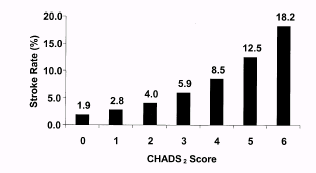
The figure above illustrates the increasing risk of stroke with higher CHADS2 score (JAMA 2001;285:2864-2870).
Some patients may be classified as being at low risk for thromboembolism using the CHADS2 scoring system but at high risk using another classification system. For example, a person with a dilated cardiomyopathy and severe systolic dysfunction of the left ventricle would only have a CHADS2 score of 1 and be at low or low-moderate risk. Yet this patient will be at high risk using the SPAF III classification system..
The development of the CHADS2 scoring system amalgamating clinical risk factors identified by other groups was then validated in the USA using data from the National Registry of Atrial Fibrillation (JAMA 2001;285:2864-2870). In this analysis the CHADS2 score was superior to two other well recognised schemes.
In other analysis the CHADS2 method performs as well as or slightly better than other risk stratification systems (Circulation. 2004;110:2287-2292) but was not markedly superior to other stratification schemes. Thus, we need to use some caution in only relying on the CHADS2 system. All risk stratification systems seem to perform well in identifying low risk patients that can or should be treated with low dose Aspirin alone.
The use of echocardiographic information may provide further information but which parameter should be regarded as being most useful is not known. Until further studies clarrify the situation, I think an intuitive approach remains appropriate such as assigning a higher risk in some with AF and severe LV systolic dysfunction. Intuitively, a person with hypertension only as a risk factor but with echo evidence of moderate or severe diastolic dysfunction with moderate or more significant atrial enlargement may also be considered as being at higher risk than implied by a CHADS2 score of one.
Hitesh Patel, Cardiologist
July, 2009