---
Atrial Fibrillation
- Issues in Management of AF
- Should We Maintain Sinus Rhythm?
- Anticoagulation in AF
- Clopidogrel
- Anticoagulation slightly better than Clopidogrel with Aspirin
- Clopidogrel with Asprin better than Aspirin alone for those not eligible for anticoagulation
- Cardioversion
- Use of ACE-inhibitors or ARBs
- Non-Pharmacological Therapy
Role of transoesophageal echo in cardioversion
If the patient has been in atrial fibrillation for more than 48 hours then there are two options:
- anticoagulate the patient for at least three weeks before attempting DC cardioversion
- exclude presence of thrombus in the left atrium with transoesophageal echocardiography and proceed to DC cardioversion. The patient does not need to be anticoagulated for three weeks beforehand but for at least 24 hours prior to and for at least three weeks after DC cardioversion
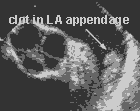 If the patient has been in atrial fibrillation for less than 48 hours it is usually safe to proceed directly
with pharmacological or electrical cardioversion. However, if a patient is at particular high risk
for development of atrial thrombus, I would recommend cardiologist consultation prior to DC cardioversion.
Patients with rheumatic mitral valves or severe diastolic dysfunction due to hypertrophic cardiomyopathy
are examples of patients that might be included in this category.
If the patient has been in atrial fibrillation for less than 48 hours it is usually safe to proceed directly
with pharmacological or electrical cardioversion. However, if a patient is at particular high risk
for development of atrial thrombus, I would recommend cardiologist consultation prior to DC cardioversion.
Patients with rheumatic mitral valves or severe diastolic dysfunction due to hypertrophic cardiomyopathy
are examples of patients that might be included in this category.
If there is uncertainty about the duration of atrial fibrillation it is wise to err on the side of caution
In some centers overseas, transoesophageal echo guided cardioversion is usually available quite readily for all patients. It offers the advantage of earlier return to sinus rhythm for patients. This is particularly beneficial to those patients who tolerate atrial fibrillation poorly either because it causes heart failure or if the heart rate response to atrial fibrillation is very rapid and difficult to control- these patients should be discussed with a cardiologist and considered for hospital admission.
Resource constraints at various centers will limit the availability of this approach for all patients. A transoesophageal echo guided approach is not a superior strategy for all patients and selective use of this approach is reasonable.
There will be instances where transoesophageal echocardiographic images will not be of sufficient clarity to allow one to proceed with DC cardioversion immediately.
The ACUTE trial showed that the transoesophageal echo guided approach was as safe as the conventional approach. Thromboembolic events have occurred even after a "clear" prior transoesophageal echocardiogram. These thromboembolic events are at times is due to formation of thrombus within the left atrium after cardioversion. Post-cardioversion thrombus formation is thought to occur if there is prolonged stunning of the left atrium ie even though sinus rhythm is restored there is delay in recovery of mechanical function allowing continued stasis of blood. To minimise this risk anticoagulation has to be continued after cardioversion, usually for at least three weeks.
Hitesh Patel, Cardiologist14th November, 2004
Reference
Klein AL, Grimm RA, Murray RD, et al. Use of transesophageal echocardiography
to guide cardioversion in patients with atrial fibrillation.
N Engl J Med 2001;344:1411-20.