---
Primary Prevention of Cardio-Vascular Disease
- NZ Guidelines
- NZ Guidelines Group Website
- Threshold for Pharmacologic Treatment. Risk Tables
- Emerging Risk Factors
- Adjusting Risk for Additional Risk Factors
- USA Guidelines
- Additional Risk Factors
- The INTERHEART Study
- Significance of Conventional Risk Factors in Different Races
- BMI measurement leads to underestimation of obesity
- Diabetes
- New targets for management- notes from ASEANZ 2009
- Controversies- notes from ASEANZ 2009
- Macrovascular complications- more than just HbA1C- notes from ASEANZ 2009
- The Metabolic Syndrome
- Looking Beyond LDL and HDL Cholesterol
- Supplements
- Non-Invasive Measures of Atherosclerosis: CT Coronary Calcium Score
Use of Imaging Techniques to Better Predict Future Risk of Atherosclerotic Cardiovascular Events
Not surprisingly, patients and doctors have looked to improve individual's risk stratification, to identify those at higher or lower risk than predicted by assessment of conventional risk factors. This has involved:
- measurement of novel emerging risk factors such as highly sensitive CRP or lp(a).
- use of diagnostic tests as screening tools, such as lowering the threshold for use of treadmill stress tests in those with "many risk factors" despite the lack of supporting evidence for the cost-effectiveness of this strategy.
- investigating the potential usefulness of imaging tests to detect significant asymptomatic atherosclerosis. Measurement of coronary calcium burden and measurement of carotid intimal media thickness are two such tests.
The early uptake of treatment strategies, based on non-randomised trial data may later be supported by confirmatory evidence from randomised trials. However, as was the case with hormone replacement therapy for women or use of folic acid to reduce homocysteine levels, randomised trial evidence may actually refute preconceptions of benefits of certain treatments.
New Prospective Trial Data on Predictive Value of Coronary Calcium Screening
The use of screening for coronary calcium has been highly controversial. Coronary calcium screening supposedly was driven by companies attempting to promote the use of their fast CT scanners. This lead to strongly held divergent opinions and controversy.
One measure of the usefulness of calcium scoring would be to demonstrate that one can refine the risk estimate of future cardiovascular events based on data from Framingham- this refinement may mean that the risk estimate is appropriately increased or decreased in some persons.
Retrospective analysis of data had suggested coronary calcium screening did provide additional information. Prospective data are beginning to emerge.
The St Francis Heart Study (J Am Coll Cardiol 2005;46:xxx-xxx) suggests calcium scores is better than the Framingham risk estimate.
One of the findings of the study relate to those that have a Framingham risk estimate of 10-20 percent for cardiovascular events over ten years. Calcium scoring helped identify those whose risk was lower than predicted and a high risk group whose risk was higher than predicted. This is shown in the graphic below demonstrating marked differences in event rates in this intermediate risk group when the group was divided into tertiles of calcium score.
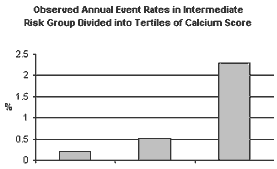
The graphic below shows the marked increase in risk with rising calcium scores.
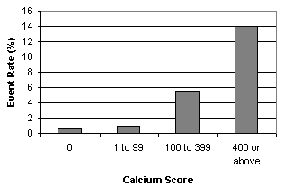
Even among those whose Framingham risk estimate was a greater than twenty percent ten year cardiovascular event rates, coronary calcium scores were useful in improving risk stratification.
Many questions remain unanswered, such as:
- the cut-off calcium score values to change the risk estimate.
- the impact of age on the calcium score cut-off- a higher value will be needed for older persons.
- the impact of race on the calcium score cut-off- for example, it is known that African Americans have higher risk of future events and a lower cut-off may be required.
- the magnitude of benefit of treatment guided by the use of calcium scoring.
- the cost-effectiveness of any screening strategies using calcium screening
The early use of tests and treatment strategies is not uncommon but does require careful consideration and debate. The same care will be required if we begin to use coronary calcium screening for risk stratification.
Prominent Cardiologist Now Accepts Calcium Scoring is Useful
A prominent cardiologist in the USA, Dr Scott Grundy, has been reported on theheart.org as conceding that calcium scoring is a useful test, one that he would use if the test was readily available to him.
Hitesh Patel, CardiologistFirst posted- 3rd July, 2005
Minor Modifications- May, 2009