---
Risk of Recurrent Events
Higher Early Risk after Acute Events
The risk of recurrent events after an initial acute event (such as myocardial infarction) is often higher in the first few weeks or months. This pattern is illustrated in figure 1.
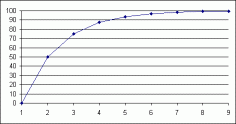
Figure 1: This graphic displays high recurrent event rates early. Intervention at the earliest stage has the potential to produce the greatest benefit. For the sake of simplicity, this graphic shows the event curves flatten out such that there is no chronic risk.
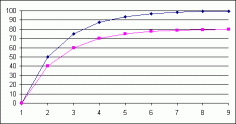
Figure 2: This graphic displays the effect of early use of a therapy which reduces event rates by 20 percent.
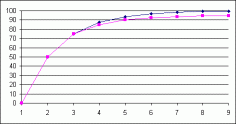
Figure 3: This graphic displays the effect of use of the same therapy but provided after a delay. In other words, if there is significant systematic delay in provision of a proven therapy, then the treatment will not provide the same benefit compared to treatment provided earlier.
The benefit/risk ratio or the cost-effectiveness of the therapy will be much reduced. This reduction in benefit might occur, for example, if there are significant delays to coronary bypass surgery for patients that have had a minor myocardial infarct. Clearly, the magnitude of the lost potential will not be the same for all patients waiting for bypass surgery.
Another example would be if there are delays to using clopidogrel with low dose aspirin after an acute coronary syndrome- if there is such a delay then the individual can not expect to receive the same benefits from treatment as shown in the CURE trial.
Constant Risk in Chronic Stable Conditions
In stable chronic disease the risk of future events is much more constant. This is illustrated in figure 4, which also shows the impact of a treatment strategy that reduces risk by 20 percent.

Figure 4: This graphic shows the impact of using a therapy that reduces event rates by 20 percent.
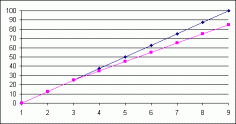
Figure 5: This graphic shows the impact of delays in introduction of this same treatment. Although, some of the potential benefit is still lost, this loss is not as great as in conditions with higher initial event rates.
The magnitude of the loss of potential benefit is dependent on the underlying risk. If the underlying risk is relatively low, then the loss in absolute terms is less compared to instances where the underlying risk is higher. For example, the loss of potential benefit is greater for delays to coronary bypass surgery for those with severe left main stem disease compared with those with stable three-vessel disease with good left ventricular systolic function.
Higher risk after an acute event followed by lower chronic risk
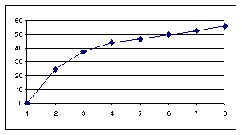
Figure 6: This graphic shows the event curves that result from higher early risk following an acute event followed by lower chronic risk for the subsequent event.
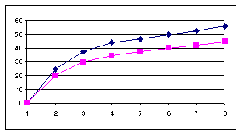
Figure 7: This graphic shows the impact of a therapy that works equally well in the early post-acute phase and the chronic stages at reducing events. In reality, the magnitude of benefit of therapy is likely to vary between the two stages.
Final Comments
To estimate the risk to an individual patient is not always easy. One has to combine the higher risk that follows an unstable episode (such as unstable angina/non-ST elevation infarction) and the constant risk associated with having a "stable" underlying condition (such as coronary artery disease). The cumulative risk will change with time. For each patient, the relative contributions and magnitude of each risk with be different.
The situation can be even more complex when one tries to calculate the overall risk of adverse outcome. For example, in ischaemic heart disease, this might comprise the risk of recurrent infarction, of troublesome angina, of heart failure, and of sudden and non-sudden cardiac death. The risks of each event at any particular moment will vary for different patients.
Many of the pharmacological and interventional therapies proven to be helpful after myocardial infarction will provide greater benefits if used early.
Hitesh Patel, Cardiologist25th July, 2004